The inspection is Thursday. The certificate is in someone's inbox.
The situation
A ship manager running twenty vessels holds the same information four times over: on board, at the technical office, with the class society, and in the inbox of whoever handled it last. None of the four is authoritative. When a port state control inspection lands, somebody spends three days establishing which version of a document is current — and the answer arrives after the decision has already been made.
The same fracture shows up in procurement. A requisition is approved ashore against a policy that lives in a PDF, by someone who was not on board when the part was specified. Nobody is doing anything wrong. The information simply is not in one place at the moment it is needed.
The constraint
A vessel is the most hostile deployment environment we work in, and every decision below follows from it.
The link drops. Satellite connectivity is intermittent and the bandwidth is narrow, which means the system cannot assume shore is reachable at the moment a decision is required. There is no engineer on board to restart anything. There is no maintenance window that suits us — the ship is working. And no fleet operator will put new hardware on twenty vessels to try someone's software.
So: no hardware change, deployed over the connectivity that already exists, and correct behaviour when the link is gone rather than an error message.
What we built
Six-plus agents on a microservice architecture in a hub-and-spoke topology, connecting ship and shore and covering three jobs previously done by people reading documents: compliance monitoring, document search across fragmented ship and shore archives, and procurement audit.
Three engineering decisions carry it.
The agents render verdicts, not answers. This shipment breaches policy. This requisition is anomalous against the last two hundred. This certificate does not reconcile with the one on board. A verdict has to be right, has to say why, and has to know when to stop and hand over to a person — a different engineering problem from an assistant that offers suggestions.
Retrieval is grounded with source attribution. In a compliance setting an unattributed answer is worse than no answer, because it invites reliance. Every verdict is bound to the passages it actually rests on, not to the documents that happened to be in scope.
Context is compressed, by roughly two hundred times at the LLM layer. Not an optimisation — it is what makes the system affordable at fleet scale. Running agents across the full document corpus of twenty vessels without it would cost more per query than the work it replaces.
Deployed over existing Starlink connectivity. No hardware change on board.
A question, the answer, and the report it rests on
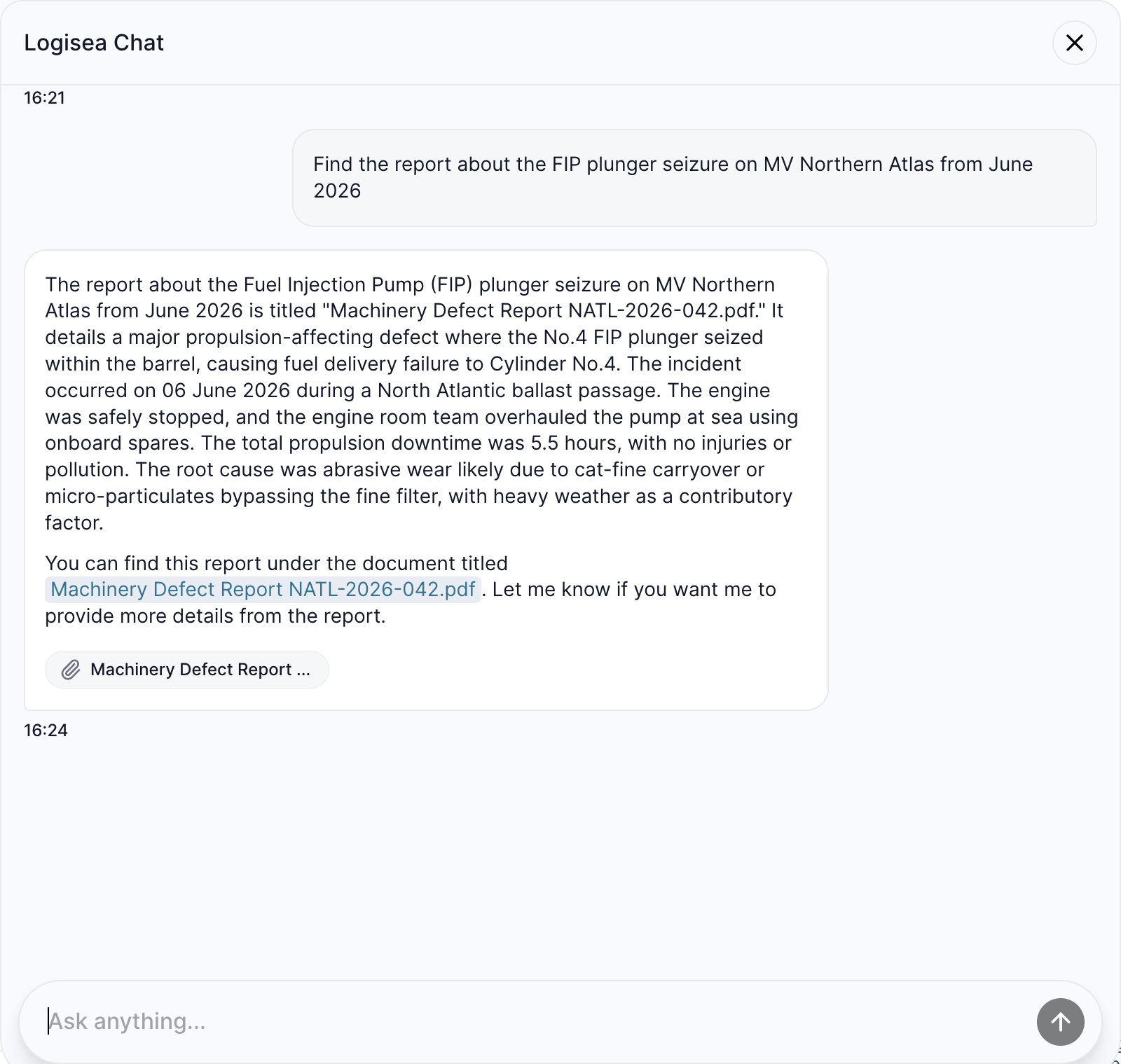
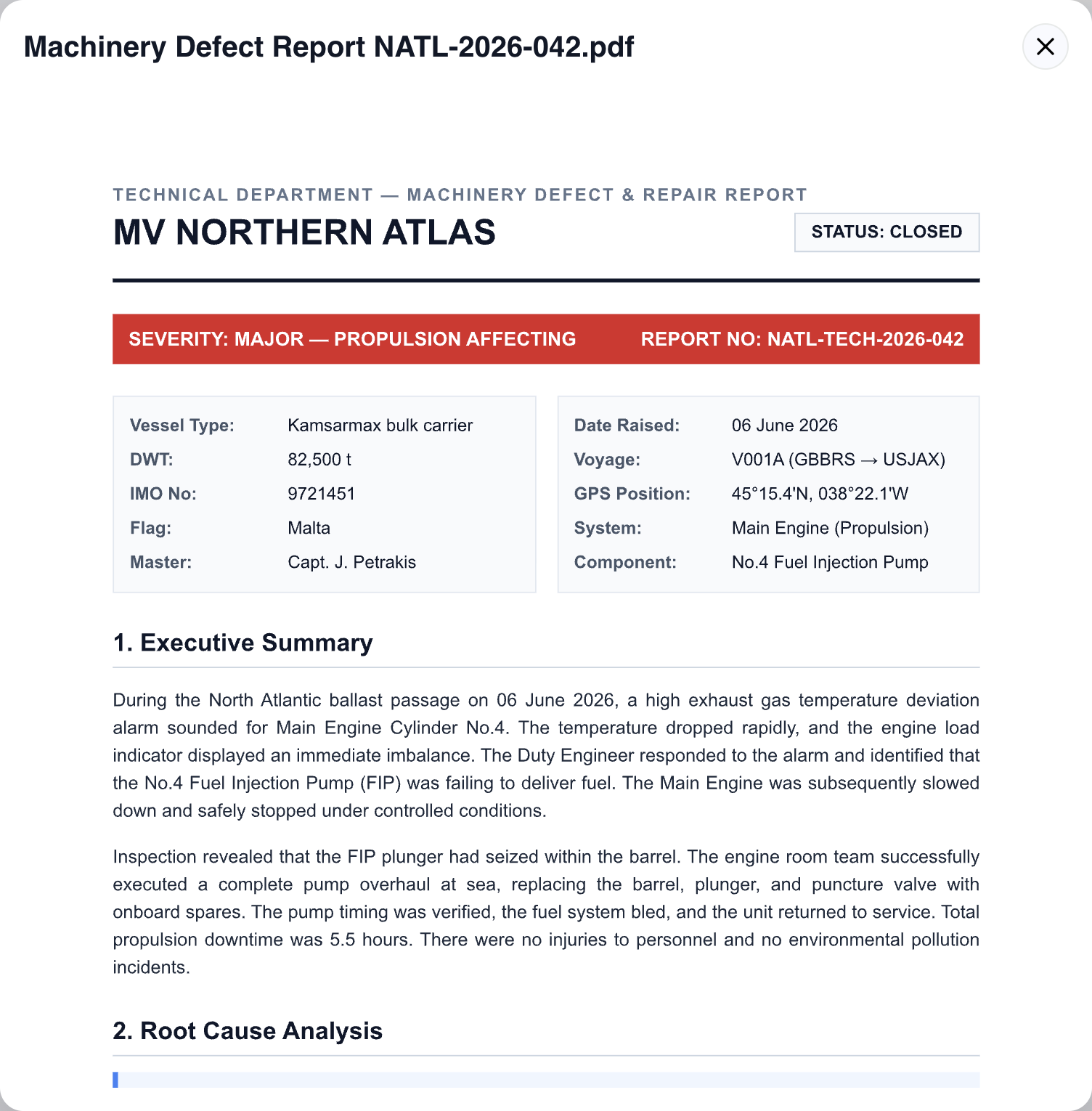
The first screen is what a fleet manager sees. The second is the report the answer names, opened: the date, the component, the five and a half hours and the cause are all in it.
Own product, demo data.
Where it stands
Three vessels in installation. That is the honest number and it goes in the first meeting.
What we can already show, and what we are counting from day one:
About the savings figure
We model $340K per ten-vessel fleet per year. It is a model, not a measurement — no fleet has been on the system for a year yet.
We show the model rather than the headline: the inputs, the hours it assumes, the rates it uses, and which lines are conservative. Anyone who wants to argue with a number should be able to see where it comes from, and a superintendent who can rebuild our arithmetic in his own spreadsheet is worth more to us than one who took a figure on trust.
The figure gets replaced with measured data as the first installations complete a year.
What it needs to work
The arithmetic works from about five vessels up. Below that, the coordination overhead the system removes is small enough that a competent superintendent absorbs it, and we say so on the call rather than after the invoice.
It reads what exists, finds what is current, and flags what does not reconcile. Class society judgment stays where it is; the decision, and the authority to overrule the system, stays with a named person.
It needs documents that are already digital. A fleet whose documents are not is a different, cheaper, less interesting project, and it comes first.
What this proves
Multi-agent operation under real infrastructure constraints, grounded attribution in a regulated setting, and integration with existing ship and shore systems. A system that works on a vessel with a dropping satellite link will work in anything a European distributor's server room does to it.
Forty-five minutes. Bring two or three real documents — the ones that do not fit the pattern. We will run them on screen and tell you what the work would be.