Airports
A departure slips forty minutes. Somebody has just been given an hour, and nothing in the terminal knows it happened.
The AODB knows. The displays know. The units forty metres from that gate do not, the passenger sitting in front of them has been told only that they are delayed, and the hour passes at the gate. We read what the terminal already knows and turn it into revenue that is currently not being made.
People arrive here when non-aeronautical revenue per passenger has flattened, when a terminal expansion has been ruled out or postponed, or when a retail concession is up for renegotiation and both sides want a number that is not last year's number.
This is the two things we do, applied to a terminal
A system built from zero, containing agents that decide rather than suggest, standing on operational data that was never assembled for this purpose. The same engineering as everywhere else on this site.
What is different is who buys it and what they count. A COO counts hours removed. A commercial director counts revenue per passenger, against a concession agreement and a footfall forecast, and will bring both to the second meeting.
The category is occupied. Airports are already sold passenger offers triggered by location, and a commercial director who has sat through one of those meetings will recognise the shape of this before the first slide is finished.
What differs is underneath. The trigger is a schedule event in the AODB rather than a device seen on a network, the routing is your terminal plan and its walking times rather than proximity, and it installs with no app and nothing stored about a person. What does not differ is procurement: there is no budget line for this, and that is the harder half of the sale.
What this actually involves
Reading the AODB and FIDS — the operational truth of a terminal, in the systems that already hold it, without asking anybody to enter anything twice.
Turning a schedule event into a zone-level picture — which gates, which piers, how many people, and how long they now have.
Walking time as a first-class input — a unit ninety metres and one level away is a different proposition from one at forty metres, and the terminal plan already knows which is which.
Tenant opening hours and capacity — an hour routed to a closed unit is worse than no hour at all, because it is spent.
Deployment with no app and no personal data — nothing to download, nothing to consent to, nothing stored about a person. This is an architecture decision made at the start, not a privacy policy written at the end.
Operating through seasonal reconfiguration — schedules change, tenants change, piers close for works, and none of that should require us.
Handover — the model, the configuration, the zone logic and the numbers are yours, with no lock to us and none to a model provider.
How the work runs
- Understand — 2 weeks on 30 days of your own AODB or FIDS export, your terminal plan with walking times, and your tenant list. Not a workshop and not a benchmark from another airport.
- Design — the zone logic, the routing rules, and the deployment architecture that keeps personal data out of it entirely.
- Build — 12 weeks, one terminal.
- QA — the surface checked against the live feeds before a passenger sees it: a gate change on the AODB has to reach the screen, and the walking time has to match the terminal plan.
- Integrate into your landscape — read-only against the AODB. Writing to it stays outside the scope, and outside the request.
- Hand it over — with the numbers, so the next negotiation with a concessionaire uses your data rather than ours.
- Support — through a season, including the reconfigurations. Terminals change their layout more often than software expects them to.
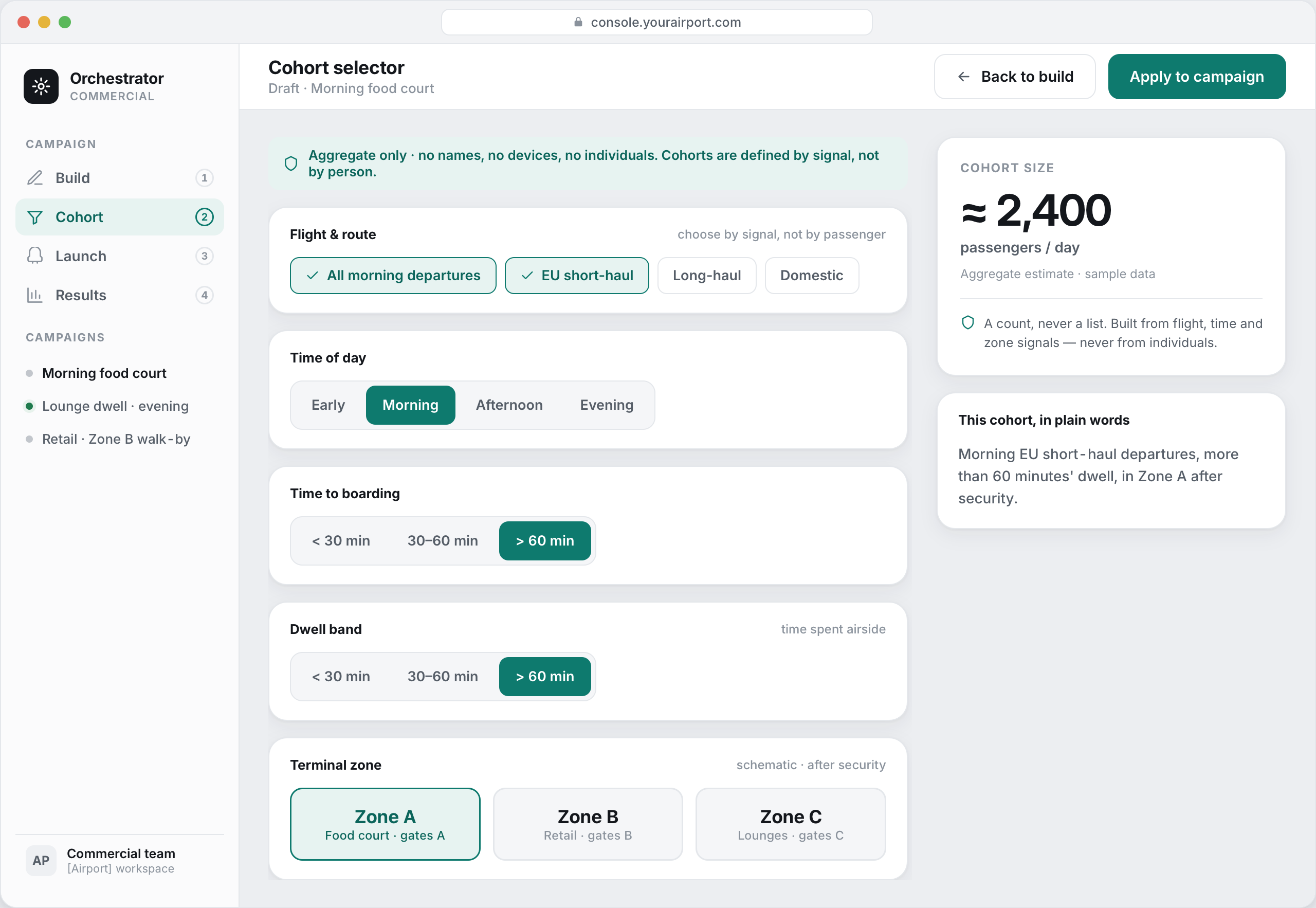
The cohort selector from the Airport Journey Orchestrator console. Every axis on it is a signal — flight and route, time of day, time to boarding, dwell band, terminal zone — and the figure on the right is the size of the set those signals describe.
There is no list behind that count to open. The screen is the whole of the claim above it: a console that cannot name a passenger, because the system never holds one.
The hour, taken apart
STD 14:20 · departure slips to 15:00 · one narrow-body departure, the whole aircraft
Where the forty minutes sit
The hour you can sell
- Seated at the gate, already airsideReachable, and not spending
The four that are not yours to move
- Airside, walking or browsingReachable, and already spending
- Landside, still at check-in or securityNot reachable, and not yours to move
- In a loungeReachable, and contractually complicated
- Crew and staffNot passengers
What the terminal knows about it
- 14:45The airline updates the ETD in the AODB
- 14:48FIDS flips to DELAYED
This is the entire system event. Nothing else in the terminal knows. Not the units. Not the lounge. Not the person who leases the unit forty metres from that gate.
What decides whether that hour is sellable
- Walking time from that gate to the nearest open unitThe terminal plan
- Whether that unit is open at this hourTenant opening hours
- Whether the passenger believes they have timeWhat FIDS told them, and nothing else
A passenger's willingness to leave the gate is set by a display designed to prevent missed flights, and by nothing designed to do anything else. Nobody manages that. We do.
Four of the five groups are not addressable. That is the honest shape of this, and any proposal that does not say so is describing a different terminal from yours.
Three packages, and how to buy without a tender
| Package | Duration |
|---|---|
| V1 · Finding the hour | 2 weeks |
| V2 · Terminal pilot | 12 weeks |
| V3 · Rollout and operation | per terminal |
V1 takes 30 days of your AODB or FIDS export, your terminal plan with walking times, and your list of commercial tenants. You get back where the controllable hour is lost in your terminal specifically, a model of the non-aeronautical uplift by zone in your airport's absolute numbers, and the deployment schema — no app, no personal data. Credited against the pilot.
The model is a model. It is built from your inputs and it is labelled as one. It becomes a measurement after the pilot, and not before — and if anyone shows you a number for your airport before reading your AODB, they made it up.
Two things about the pilot price that are unusual enough to say out loud.
We tie it to the uplift V1 modelled. The pilot does not cost more than a tenth of the modelled annual uplift for that terminal. That way the number is defended in your meeting with arithmetic rather than with our confidence.
We price it under your direct-award threshold where we can. Airports in public or mixed ownership have a figure above which a direct contract stops being possible and a procedure begins. That constraint is often harder than the budget, and it is usually the reason a pilot everyone wanted takes nine months. Tell us the figure early and we will scope to sit under it. The right price here is the largest one below your threshold — not the largest one.
Where this stands
Airport Journey Orchestrator is our own system. A twelve-week terminal pilot is scoped, and the first engagement is at contract stage.
It has not run in a terminal. There is no airport we can point you at and no footfall we can show you, and the first airport to sign this will be the first airport to sign it — which is worth naming plainly, because it is the whole negotiation.
What exists is the engineering: four systems we built and run in four industries, two of them integrating into operational databases we did not design, under constraints on bandwidth and data residency. That is what a first airport is actually buying, and it is why the first step is paid rather than free.
What this assumes
Read-only against the AODB, and it stays read-only.
Wayfinding tells a passenger where things are. This decides whether telling them is worth doing at all right now.
Your retail inventory stays yours. We make the hour visible and route it; the commercial relationship with the tenant is yours, including the upside.
No app, and no personal data. That is the architecture, and a proposal needing either is somebody else's work.
If you control neither the captive portal nor the right to place a QR code in that pier, V1 will tell you so in week one, and that is a legitimate outcome of V1.
This is taken on directly. As a subcontractor we are a day rate; here we are the ones building it, and those are different businesses.
Underneath this sits the same work as everywhere else on this site: a system built from zero, agents that reach a verdict, and an operational data layer that had to be assembled first.
Forty-five minutes. Bring a day of your AODB or FIDS export and your terminal plan. We will take a real delayed departure apart on screen and show you where the hour went.